
Why Every Business Needs a Structured Recovery Partner
- 19th June, 2026
- Vinayak Padiyar
- 0 Comments
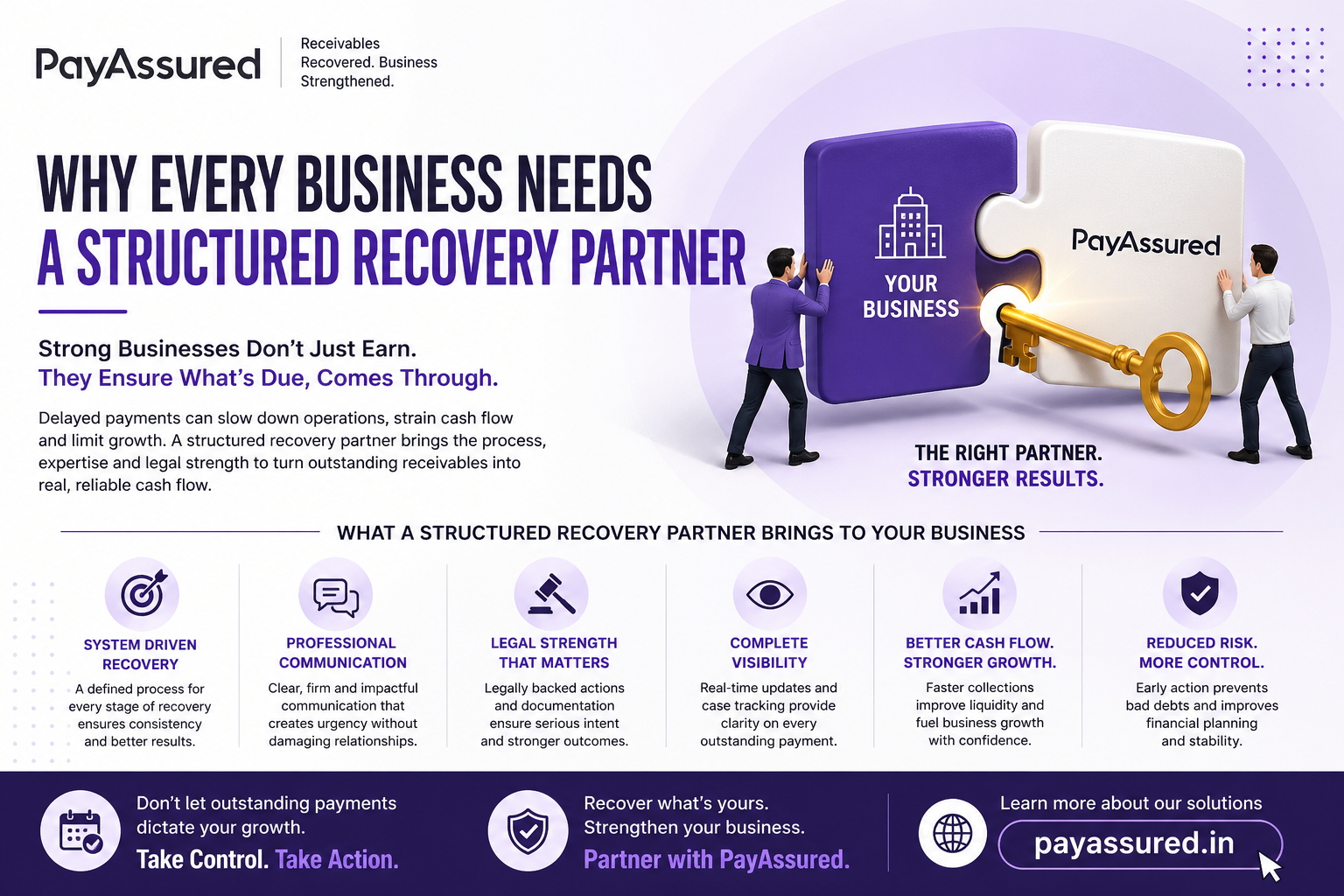
Every business is built around growth. Sales targets are set, pipelines are filled, and teams work continuously to bring in new revenue. On the surface, everything may look strong. Invoices are raised, numbers reflect progress, and the business appears to be moving forward. But the real strength of a business is not measured by how much it invoices. It is measured by how much actually comes into the bank. When payments are delayed, the impact is not immediate, but it builds quietly in the background. Cash flow starts tightening, operational flexibility reduces and growth begins to slow in ways that are not always visible at first.
This is where outstanding receivables become a serious concern. Almost every business deals with delayed payments to some extent. What starts as a few overdue invoices can gradually turn into a larger pattern. Payments expected in thirty days move to sixty, then ninety, and sometimes even beyond. As this continues, a significant portion of working capital remains stuck outside the business. That gap between revenue earned and cash received creates pressure across departments. Vendor payments get delayed, new investments are postponed, and internal decisions become more conservative than they should be.
Most businesses attempt to manage this internally. Teams follow up with clients, reminders are sent, and calls are made to push for payments. While this effort is necessary, it often lacks structure. Follow ups depend on availability, priorities shift, and recovery becomes reactive rather than planned. There is no defined process that ensures every case is handled consistently. Over time, this leads to gaps. Some cases receive attention while others are delayed. Communication becomes inconsistent, and the impact of follow ups starts to weaken.
A structured recovery partner changes this completely by introducing a system where none existed before. Instead of handling cases randomly, every outstanding payment is treated as part of a defined process. There is clarity on how a case begins, how it progresses, and what actions are taken at each stage. This structured approach ensures that no case is ignored and no delay goes unaddressed. It replaces uncertainty with consistency, which is one of the most important factors in successful recovery.
Another important shift comes in the way communication is handled. Informal reminders often fail because they do not carry enough weight. They signal flexibility rather than urgency. A structured recovery partner brings professionalism into every interaction. Communication becomes clear, firm, and purposeful. It reflects that the matter is being handled seriously, without being unnecessarily aggressive. This balance is critical because businesses often want to recover payments without damaging long-term relationships. A structured approach ensures that pressure is applied in the right way, creating urgency while still leaving room for resolution.
There is also a legal dimension that cannot be overlooked. Many recovery situations require more than persistence. They require proper documentation, legal understanding, and the ability to escalate when necessary. A structured recovery partner brings this capability into the process from the beginning. Every step is aligned with legal standards, which strengthens the position of the business. Whether it is formal communication or further legal action, the process remains compliant and effective. This often leads to faster responses from the other side, simply because the seriousness of the situation is clearly established.
Visibility is another major advantage. In many businesses, receivables are tracked, but not actively monitored. There is limited clarity on which cases are progressing and which are stalled. A structured recovery system provides complete visibility. Businesses know the status of each case, the actions taken, and the expected outcomes. This level of clarity allows for better financial planning and more informed decision making. Instead of relying on assumptions, businesses gain control over their inflows.
For companies that are scaling, this becomes even more important. Growth naturally brings more clients, more invoices, and more receivables. Without a proper recovery structure, the problem grows along with the business. What was once manageable can quickly turn into a major bottleneck. Cash flow issues begin to affect expansion plans, hiring decisions, and overall business momentum. A structured recovery partner ensures that growth is supported by steady cash flow, rather than being hindered by delayed payments.
Another key factor is continuity. Recovery is not a one-time effort. It requires consistent attention and follow through. Many internal teams struggle to maintain this consistency because their focus is divided across multiple responsibilities. A structured recovery partner ensures that the process does not lose momentum. Every case is followed through until resolution. There is always a next step, and there is always progress being made.
At a deeper level, having a structured recovery partner shifts the way businesses think about receivables. It moves recovery from being an afterthought to being an integral part of financial management. Instead of reacting to problems after they arise, businesses begin to manage them proactively. This not only improves cash flow but also strengthens overall financial discipline.
Because in the end, business success is not just about generating revenue. It is about converting that revenue into usable capital. Invoices do not drive operations. Cash does. And cash flow improves when recovery is handled with the right level of structure, expertise, and consistency.
That is why every business, regardless of its size or stage, eventually needs a structured recovery partner. Not just to recover what is due, but to build a system that supports sustainable growth.


