
How Faster Debt Recovery Strengthens India’s Business Ecosystem
- 20th June, 2026
- Navya
- 0 Comments
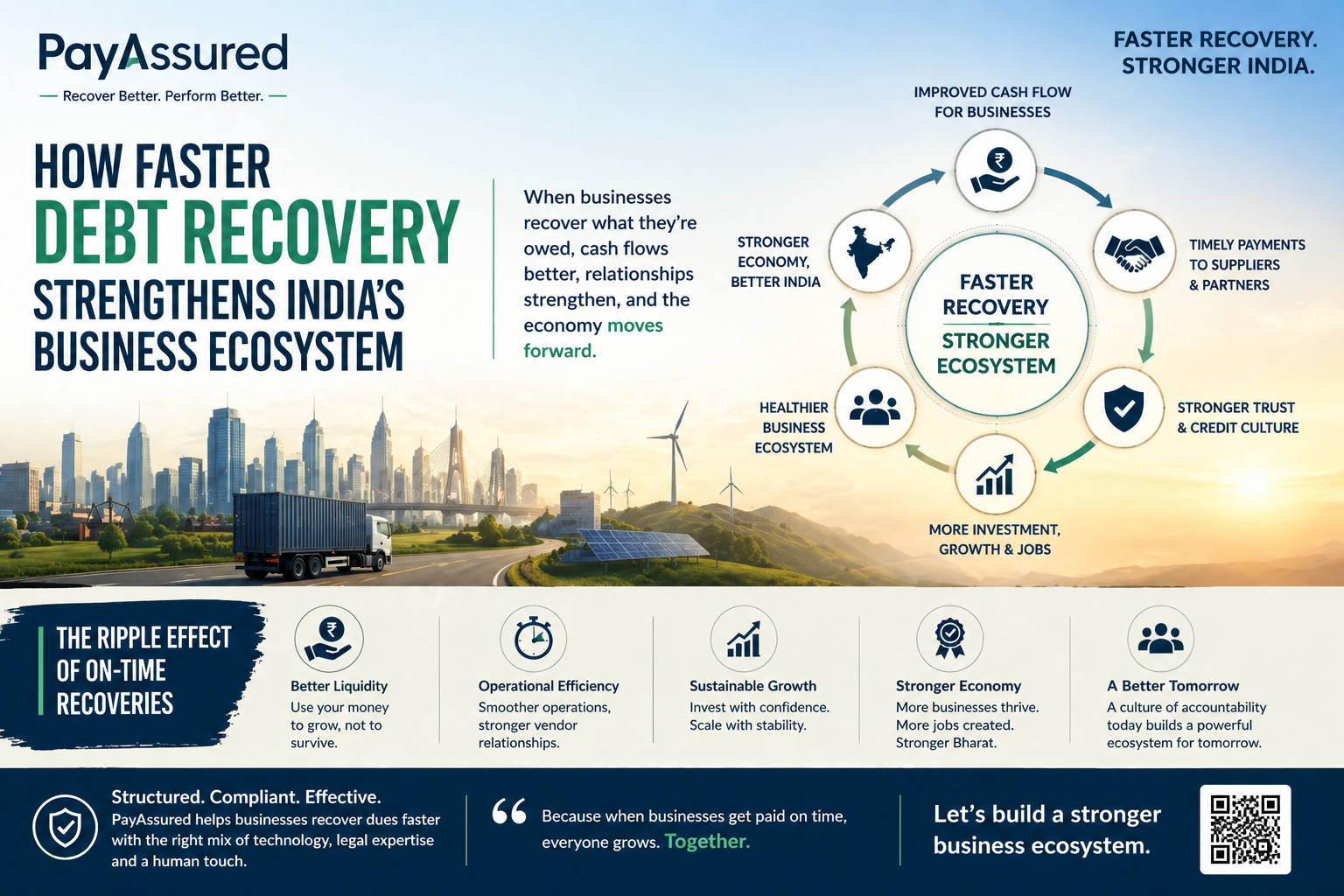
India’s business ecosystem is built on movement. Goods move, services are delivered, invoices are raised, and payments are expected to follow. On paper, this cycle looks smooth. But in reality, one delay can slow down the entire chain. When payments are not received on time, the impact is not limited to one business. It travels across the ecosystem.
That is where faster debt recovery becomes important.
Most businesses do not fail because they lack revenue. They struggle because revenue does not convert into cash when it should. Payments get delayed, receivables increase, and working capital gets locked outside the business. When this happens at scale, it creates a ripple effect across industries.
A manufacturer waiting for payment delays payments to suppliers. A supplier then delays payments further down the chain. And slowly, the entire system begins to slow down.
This is how payment delays quietly affect the larger business environment.
Faster debt recovery addresses this problem at its core.
When outstanding payments are recovered within defined timelines, liquidity improves. Businesses have access to the capital they have already earned. This allows them to operate smoothly, pay vendors on time, invest in growth, and take on new opportunities without hesitation.
And when multiple businesses experience this improvement, the ecosystem becomes stronger.
One of the key benefits of faster recovery is improved payment discipline.
When businesses know that delays will be followed up with a structured and consistent process, behavior begins to change. Payments are prioritized. Commitments are taken more seriously. The culture shifts from flexible timelines to accountable transactions.
Over time, this builds a more reliable business environment.
There is also a direct impact on trust.
In any business ecosystem, trust plays a critical role. Companies extend credit based on the expectation that payments will be made. When delays become common, that trust weakens. Businesses become cautious, credit periods shrink, and growth slows down.
Faster recovery helps restore that confidence.
When payments move more predictably, businesses are more willing to engage, extend credit, and collaborate. This creates a healthier environment where transactions flow more freely.
Another important aspect is financial stability.
Delayed payments increase financial stress. Businesses are forced to rely on external funding, manage cash shortages, and delay their own obligations. This creates inefficiencies that affect not just individual companies but the overall economy.
By ensuring quicker recovery of dues, businesses rely less on external support and more on their own earned capital. This improves financial stability across the system.
There is also a long-term impact on growth.
India’s business landscape is expanding rapidly, with companies scaling across sectors and geographies. As businesses grow, so do their receivables. Without efficient recovery mechanisms, the problem of delayed payments grows along with them.
Faster debt recovery ensures that growth is supported by steady cash flow.
It allows businesses to scale without carrying the burden of increasing outstanding dues. It ensures that expansion is backed by real liquidity, not just projected revenue.
At a broader level, this contributes to a more efficient economy.
When capital circulates faster, productivity increases. Businesses can reinvest, hire, innovate, and expand. The overall pace of economic activity improves because money is not stuck where it should not be.
And this is where structured recovery plays a crucial role.
Faster recovery does not happen by chance. It requires a defined process, consistent follow up, and the right level of legal and operational support. When recovery is handled in a structured manner, outcomes become more predictable.
This is where platforms like PayAssured fit into the ecosystem.
By bringing structure, consistency, and legal backing into the recovery process, PayAssured helps businesses convert outstanding receivables into active cash flow. It ensures that delays are addressed early and resolved efficiently.
And when businesses start receiving what they are owed, on time, the impact goes beyond individual balance sheets.
It strengthens the system.
Because at its core, an economy does not run on invoices.
It runs on cash flow.
And the faster that cash moves, the stronger the ecosystem becomes.


